
ARTIST STATEMENT
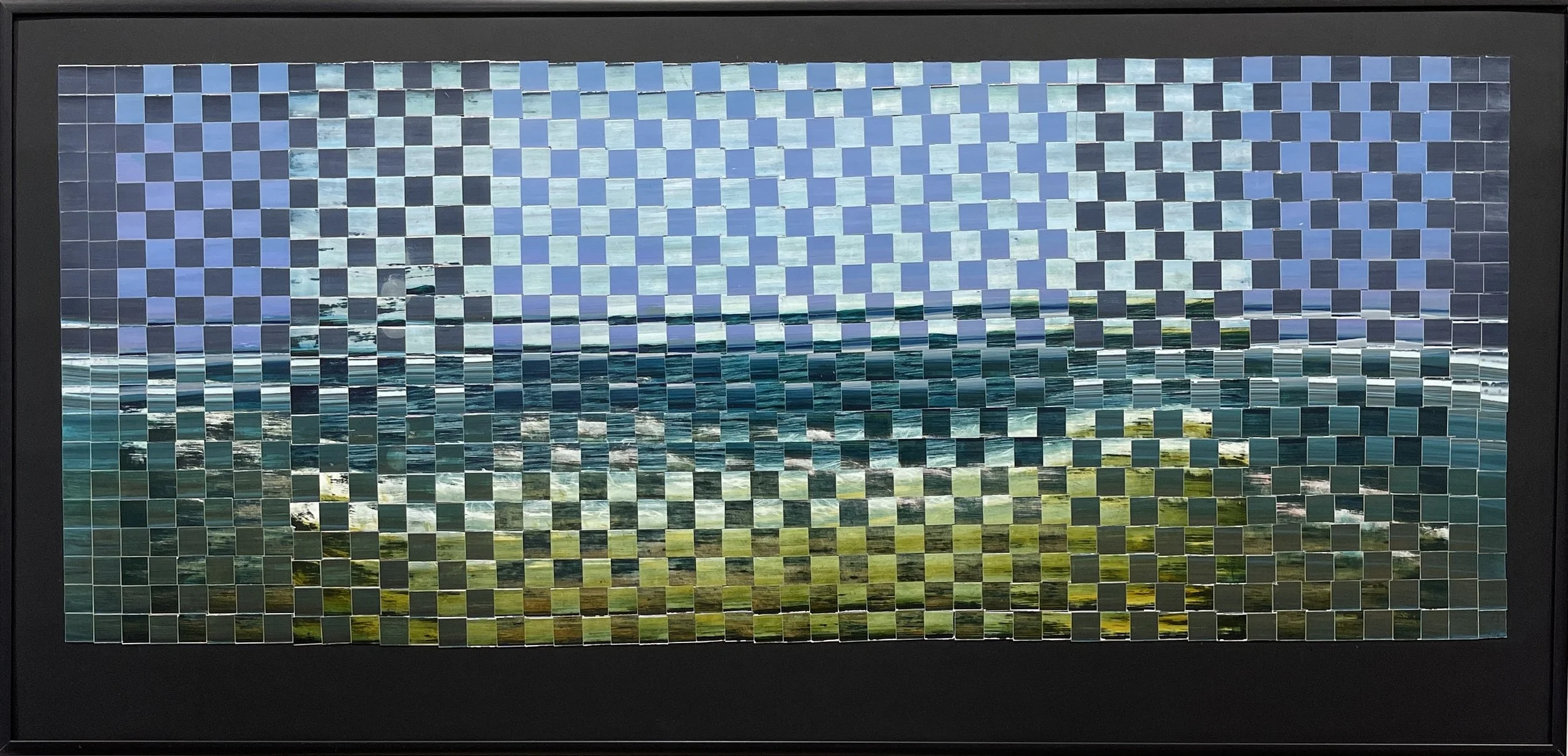
Double Visions
David Browne
As a visual artist I’ve long been fascinated by the general (mis)perception that there is a sharp and unbridgeable divide between the arts and sciences. It’s ironic that this divide, just as the disciplines which we have intentionally placed on either side of it, is a completely human-made construct, yet is perceived as something out of our ability to alter or remove altogether. Much of my work has been in the service of debunking that myth and showing that art and science are part of a flowing and interwoven continuum of human knowledge and experience. At times I’ve strived in my work to unmask and critique problems raised by this false division of knowledge. An example would be my sculptural work with common window screen fabric that mimics the digital images we take for granted on our electronic screen. That work is aimed at revealing our fundamental misperception and misunderstanding of digital technology. At other times, as with this exhibition, I’ve thought about art and science (in this instance mathematics and the science of visual perception) as collaborators that I hope may give a glimpse into the nature of human knowledge as a continuum.
In one series of paintings, I’ve used a mathematical proportion, dating to ancient Greece, called the Golden Section (also rediscovered in the 14th Century as a mathematical progression called the Fibonacci sequence after the man who discovered it) as a means of dividing two paintings into several pieces and reintegrating them to depict in a single scene: the passage of time from darkness into light or light into darkness.
In the other series, I’ve cut groups of two or three separate paintings into ½” squares (i.e. physically digitized or pixelated them) and integrated the pieces as in a mosaic using the Fibonacci and other mathematical sequences. These pieces evoke a sense of shifting perspectives or or points of view from the location of the viewer. It’s as if the viewer was moving (shifting their point of view) without moving, or in two or three places at once, or viewing the same scene at different times simultaneously with the light and hues modulating back and forth between dark and light.
It is also worth pointing out in the context of these mosaic-like pieces that they are also meant to resemble or mimic woven fabrics. I often use weaving, woven surfaces, and gridded structures in my work as analogies for our increasingly digitized environment to show how electronic digitization tends to distort, misconstrue, and miscommunicate the nature of the so-called real three-dimensional or analogue world we actually live in. At the same time, there are some theorists who have suggested that the universe, including we humans, is indeed a digital entity composed of pure information or data. So, I suggest that these paintings confront the viewer with a basic question. Are these paintings pieces of digital art that distort our familiar sense of ‘reality’, or do these physically digitized images enhance and magnify our experience and understanding of ‘reality’? Or is it both and?
About the Artist
As a visual artist I’ve developed new process-driven techniques for using traditional and non-traditional materials and for integrating the disciplines of traditional weaving, painting, and sculpture. The resulting work invites new ways of seeing the natural landscape. Landscape and weaving combine as an analog counterbalance to and commentary on digital technology.
I have a B.A. in Fine Art and Art History from Oberlin College, an M.A. in Art Education from Kean University, and an M.A. in Counseling from St. Mary’s University. I was a public school art teacher for several years before shifting to a career in social services. I’ve continued to create artwork throughout my time as a social services professional and into “retirement”.
Process is a “thread” that “weaves” itself throughout my work. It may sound counterintuitive, but I paint, weave, and make sculpture using rigid procedural frameworks. These rigid procedures actually allow randomness to play a large role in how a piece evolves. Thus when I start a painting or sculpture, I have no idea how it will appear when finished. I am often surprised myself at the finished product.
The timeline for my work as a visual artist coincides with the development of the personal computer and the very beginning of the digital revolution. In my earliest work, before the Apple Macintosh, the first personal computer with graphics capability, in 1984, I was pushing layers of paint and inks through window screens to create vibrant “digital” landscapes. I painted layered grid-like structures and broken down grids.
From the late 1990’s through 2013 I wove with fishing line on primitive hand-made looms (analog equivalents of hi-tech programming, software, and hardware) to produce translucent 3-dimensional woven sculptures.
From 2013 to 2017, I took an apparent detour away from weaving and digital concepts and made a series of over 300 panoramic landscape paintings. In retrospect, it was a detour that led straight back to the main highway of my interest in weaving as an analog version of digital technology. I discovered that the material I had been painting on to make traditional landscapes could be cut into fiber-like strands and woven together to create a “digital” or ‘pixelated’ surface. Thus, I began to produce woven landscape paintings composed of large irregularly shaped “pixels”.
In 2019 I returned full circle to where I had begun, using commercial window screen. I use the window screen itself as a sculptural medium, layering sheets of screen to create dreamlike images that appear to change as the viewer moves. The screen itself is a digital medium comprised of a grid that breaks space up into pixels, much like the screen of your cell phone, but much larger.
During this same period, and up to the present, I saw that many of my 300+ landscape paintings were quite similar and decided to engage in what I’d call creative destruction in order to further explore the visual impact of digitized images. I group paintings into sets of two or three and either 1) and cut them into ½” squares and reassemble them using patterned mathematical sequences into mosaic-like works; or 2) divide them into blocks using a mathematic formula, and assemble them into long panoramic scenes that convey the passage of time. These are the paintings which are the subject of my current exhibit: Double Visions.